
0%
Tuning 60,000 years of sound…
← Aura Music School
Aura Music School presents

The Evolution
of Sound

One golden line, 60,000 years long. Scroll — and watch it become the instrument of every age.

Scroll to begin
60,000 BCE
Bone Flute
The First Instrument

Bone, Breath & the Very Beginning

A cave-bear femur carved into a flute by Neanderthals — music is older than farming, older than writing.

🦴 Divje Babe Flute🎵 Hear it played
The Divje Babe flute — a Neanderthal bone flute
The Divje Babe flute · cave-bear femur · c. 58,000 BCE
The Divje Babe flute, reconstructed and played — heard again after 60,000 years
Music Meets Math

The Ratios of Beauty

Pythagoras halves a string: an octave. A 3:2 ratio: the perfect fifth. Every scale you practise is maths you can hum.

📐 Octave · 2:1🎵 Fifth · 3:2
The Octave · 2 : 1
Start note
2 : 1
Double the frequency and you land on the same note, one octave higher — music's most perfect consonance.
The Perfect Fifth · 3 : 2
Start note
3 : 2
Three waves for every two — the bright, stable sound Pythagoras used to build the whole scale.
Sound Becomes Visible

Guido Draws Four Lines

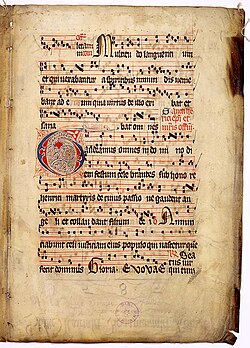
Guido of Arezzo's staff and Ut–Re–Mi let a singer perform a melody they've never heard. Music becomes data.
✒️ Neumes · 850🎼 Solfège · 1025
A Gregorian chant manuscript with early neumes
Gregorian chant with early neumes · 9th–11th century

Guido of Arezzo — the 11th-century game-changer

An Italian music theorist, Guido revolutionised music by inventing the four-line staff and the idea of solfège. For the first time in history, a musician could look at a piece of parchment and accurately sing a melody they had never heard before — music had become visual data.

UtReMiFaSolLa
The First Music Industry

Ink, Presses & Eighty-Eight Keys

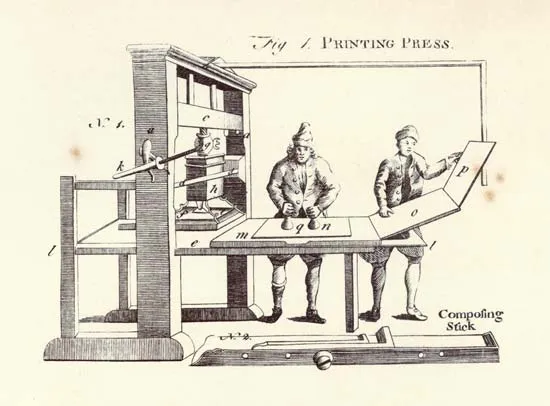
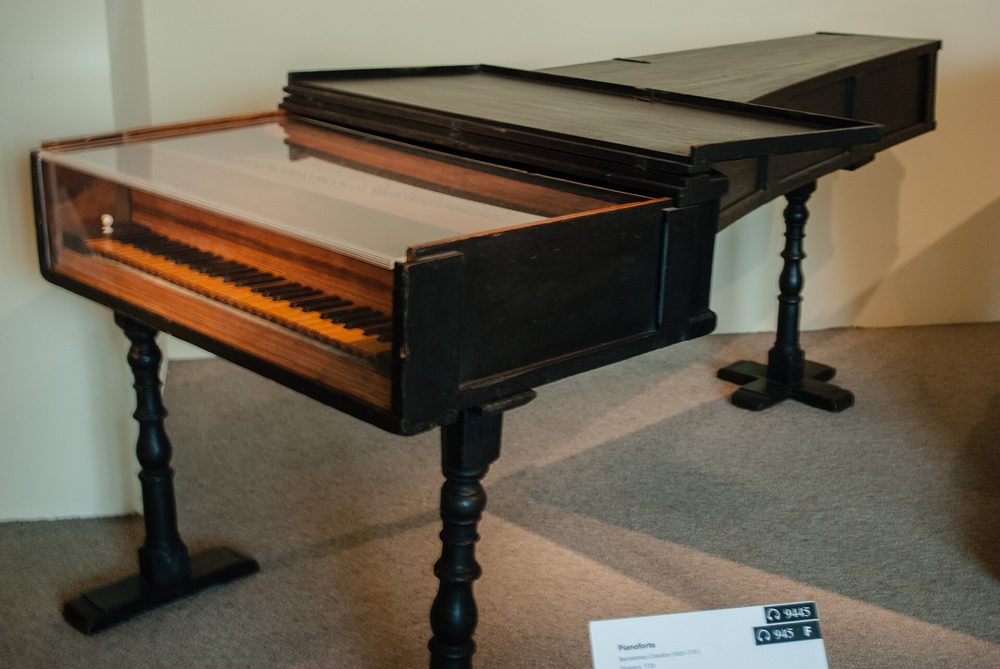
Petrucci prints sheet music for every home — and by 1700 Cristofori's piano can whisper and thunder.
🖨️ Petrucci · 1501🎹 Cristofori · 1700
An early printing press with compositors setting movable type
The printing press · movable type for music, 1501
A Cristofori fortepiano, c. 1720
Cristofori's fortepiano · c. 1720

Petrucci & the first music industry

In 1501, Italian printer Ottaviano Petrucci solved the puzzle of printing complex musical staffs and notes, using a painstaking triple-impression method with movable type. His first book, Harmonice Musices Odhecaton, democratized sheet music — the growing middle class could now buy music to play in their own homes. It birthed the idea of the "Composer" as an international celebrity.

Sound, Captured

The Wave Trapped in Wax

Edison catches sound itself; Berliner's discs mass-produce it; radio then beams it into a million rooms.

🗣️ Speak into the horn💿 One vs. a million📻 Tune the dial
Speak Into the Horn
In 1877, Edison caught sound itself — a needle scratching your voice into a spinning cylinder. Record a few seconds and hear yourself the way 1877 heard you: narrow, crackling, wobbling with the hand-crank.
Ready when you are.
Your voice never leaves your device — nothing is uploaded.
One Performance vs. a Million Copies
Edison's cylinders couldn't be duplicated — to sell ten copies, the band had to play the song ten times. In 1888, Emile Berliner's flat disc changed everything: cut one master, stamp out millions. Try both.
1877 · The Cylinder
0 copies
1888 · The Disc
0 copies
One master → a whole industry. It's why we still call them “records.”
Tune the Dial
By the 1920s, a single signal reached a million homes at once. Somewhere in the static is the first music ever sent through the air. Drag the needle and hunt for the signal.
— kHz🔊 static…
Drag slowly — the signal is narrow.
The Electric Rebellion

Distortion Was a Mistake

Pickups make guitars roar — and players overdrive "clean" amps on purpose until the failure becomes rock's voice.

🎸 Overdrive the amp🥁 Play the kit🎚️ Mix the tracks
Turn It Up Till It Breaks
Pickups let players push amps harder than the engineers intended. Past a point the signal clips — a "broken" sound guitarists chased on purpose. A riff is playing; crank the gain and watch the wave square off into a snarl.
GAIN 1.0
Warming up…
drag the knob ↑ / ↓
Distortion — the sound of an amplifier pushed past its limit.
The One-Person Rhythm Section
Before 1909 a beat needed several players. The drum kit — bass drum on a foot pedal, plus snare, hi-hat and toms — put the whole rhythm under one drummer. Tap a drum, or press the key marked on it.
A H J L S SPACE
One drummer, four limbs — the engine of every band since.
Be a One-Person Band
Multitrack recording (pioneered by Les Paul) let one song be built from separate takes — drums, bass, guitar, vocals — layered into a single mix. Mute and solo the tracks to hear how a record is assembled.
0:00 / 0:00
Loading stems…
Four takes, one machine — the birth of the modern record.
Machines Learn Music

Sound from Nothing

Moog builds tone from voltage; the "failed" TR-808 becomes pop's heartbeat; MIDI teaches machines one language.

🎛️ Sculpt a synth🥁 Program the 808🔌 One melody, any voice
Build a Sound From Nothing
Every sound before this was a recording of something real. A synthesiser invents tone from a raw electrical wave, then carves it with a filter. Pick a wave, hold a note, and sweep the cutoff — this is subtractive synthesis, the Moog's whole idea.
Cutoff2.0 kHz
Resonance5
Sawtooth · hold a note, then sweep the cutoff
Subtractive synthesis — start with a raw wave, then filter away what you don't want.
Program the Beat
Roland tried to fake real drums and failed — so producers programmed the fake sounds into patterns instead of playing them. That boom and snap became the heartbeat of hip-hop and pop. Toggle the grid to build a loop — every hit is synthesised live.
The TR-808 — a "failure" that became one of the most sampled machines in history.
One Message, Any Instrument
MIDI's trick: a note isn't a sound — it's just data (which key, how long). The same message can drive any instrument. Here's one melody as MIDI notes — swap the instrument and hear the data stay identical while the voice transforms.
▸ —
Same notes — different instrument. That's MIDI.
MIDI (1983) — one shared language that let every machine talk to every other.
The Infinite Library

Every Song, Everywhere

MP3s shrink songs, streaming opens all recorded history, and a laptop is a studio. The next sound is yours.

🗜️ What MP3 deleted🎧 Spotify🤖 AI · now
What Got Deleted
The MP3's real trick wasn't a smaller file — it was psychoacoustic masking: throwing away the sounds your ears are least likely to notice, starting with the highest frequencies. Drag the bitrate down and watch the song shrink — then listen to the ghost of everything that got thrown away.
— MBfile size
songs per GB
MP3 (1993) — small enough to fly across the internet, and "1,000 songs in your pocket."
The Finale · You Drive

The Multi-Track Timeline

Every invention from the journey, on one console. Press play — or grab the playhead and scrub 60,000 years yourself.

60,000 BCE
Drag the playhead or press play

60,000 years in five tracks

Aura Music School

Instruments · Notation · Recording · Electricity · The Digital Age. Click any clip to jump straight to it.

← drag · click a clip · ▶ plays the whole story →

Every new tool arrives with instructions — and every generation of musicians uses it "wrong" and invents the future.

Find the sounds that haven't been invented yet.

← Back to Games Aura Music School
Website created bySaurabh Parihar
The Evolution of Sound · Curated for Aura Music School · Learn • Create • Perform